
G-Rebels Made Me Want to Write About VR Again
A neon-soaked flight into the kind of ambitious, slightly unruly indie VR experience this site was built to celebrate.
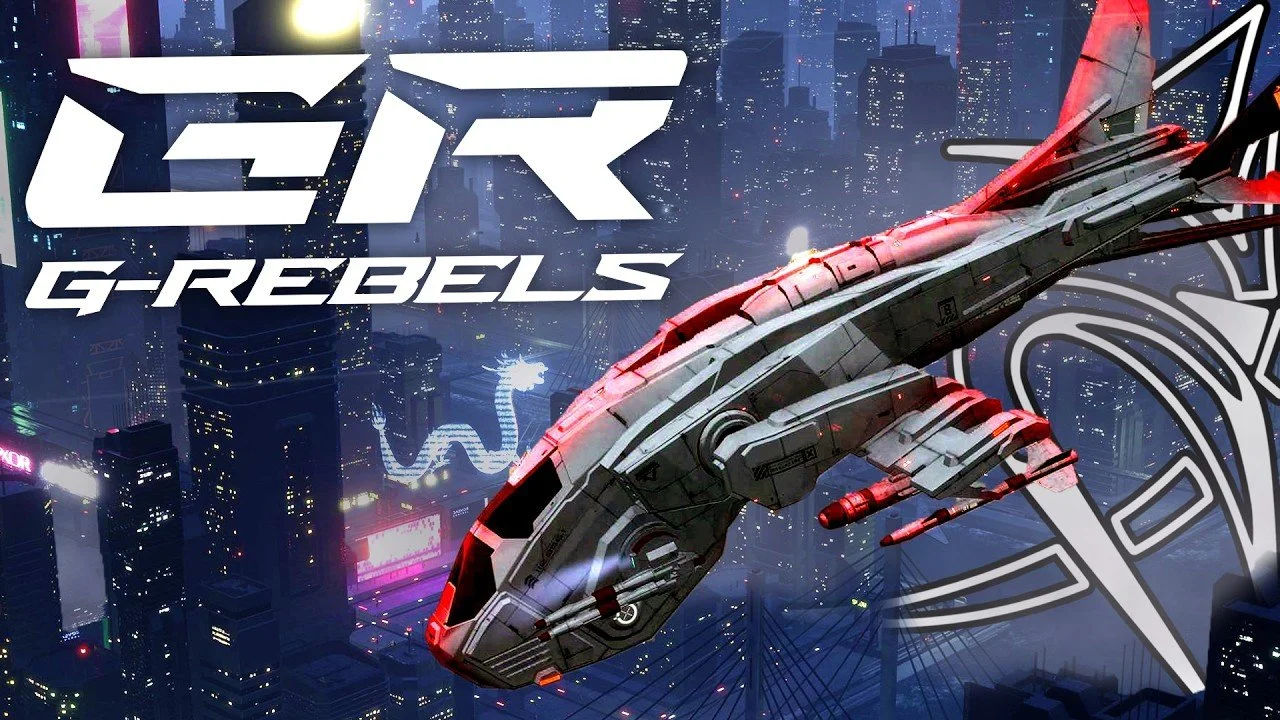
There was a specific kind of late-1990s videogame magic that came from staring at a chunky television and imagining a city far larger than the PlayStation could possibly render. G-Police made that fantasy work through rain, neon, fog, and a flying police gunship that looked like it had been designed by someone who owned both a Blade Runner VHS and a model helicopter. G-Rebels is not officially wearing that badge, but the family resemblance is impossible to miss - and honestly, that is a compliment.
It is also the reason you are reading CatsAndVR again.
If you remember this little corner of the internet, you may also remember that it has been quiet for a long time. Life happened. VR changed. Headsets arrived, disappeared, returned with better screens, and continued trying to convince our furniture that room-scale tracking was a good idea. Somewhere in that churn, I stopped posting - even though I never really stopped caring about virtual reality or the wonderfully strange independent games that keep pushing it forward.
Then G-Rebels appeared on my radar.
Not because it is perfect. It is an ambitious Early Access game with rough edges, technical demands, and a world that still needs filling in. But its combination of cyberpunk skylines, cockpit-scale VR, chunky aircraft, and unapologetically videogame ambition reminded me why CatsAndVR existed in the first place. Sometimes a game does not merely look interesting. Sometimes it pokes the dormant part of your brain that says, 'You should really write about this.'
The Future Apparently Needs Air Cops
G-Rebels is an open-world combat flight game set above a flooded Earth in 2684. Humanity survives in floating megacities, while law enforcement maintains order with armed aircraft called Skyblades. You take assignments across the Atlas Archipelago, chase criminals, race through city canyons, collect bounties, escort targets, smuggle cargo, and gradually uncover reasons to question the people issuing your orders.
That pitch is gloriously specific. This is not a game trying to be everything to everyone. It wants to be cyberpunk air-cop fiction with rain on the canopy, missiles under the wings, and enough institutional grime to make every radio transmission sound mildly suspicious. More importantly for this site, it supports PC VR - and that changes the entire character of the experience.
A Cockpit Built for VR Daydreams
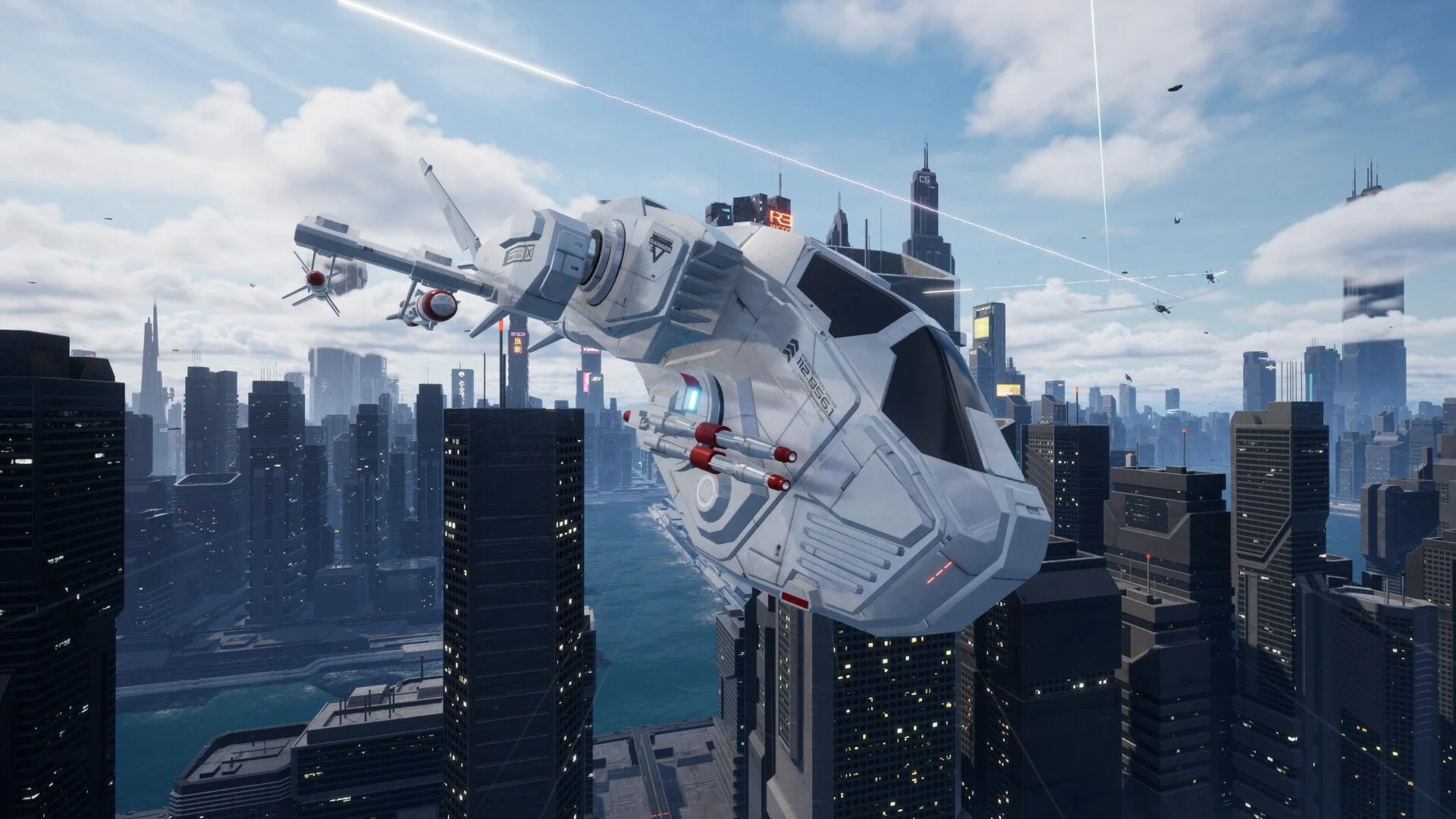
Flight games and VR have always been natural conspirators. A cockpit gives your body a fixed frame of reference, while the headset supplies the scale, depth, and mild existential vertigo that a monitor can only suggest. Inside a Skyblade, G-Rebels' huge structures stop looking like scenery and start feeling like architecture. Traffic moves around you, clouds consume sections of the skyline, and platforms hang over the drowned world like industrial islands.
The game's greatest strength is atmosphere. Volumetric clouds, weather, a day-night cycle, and a city full of moving aircraft create the sense that you are flying through a place rather than circling a combat arena. This is the sort of VR experience where the sensible tactical decision can be temporarily defeated by the desire to bank around a tower, stare through the canopy, and say something deeply analytical like, 'Oh, that is cool.'
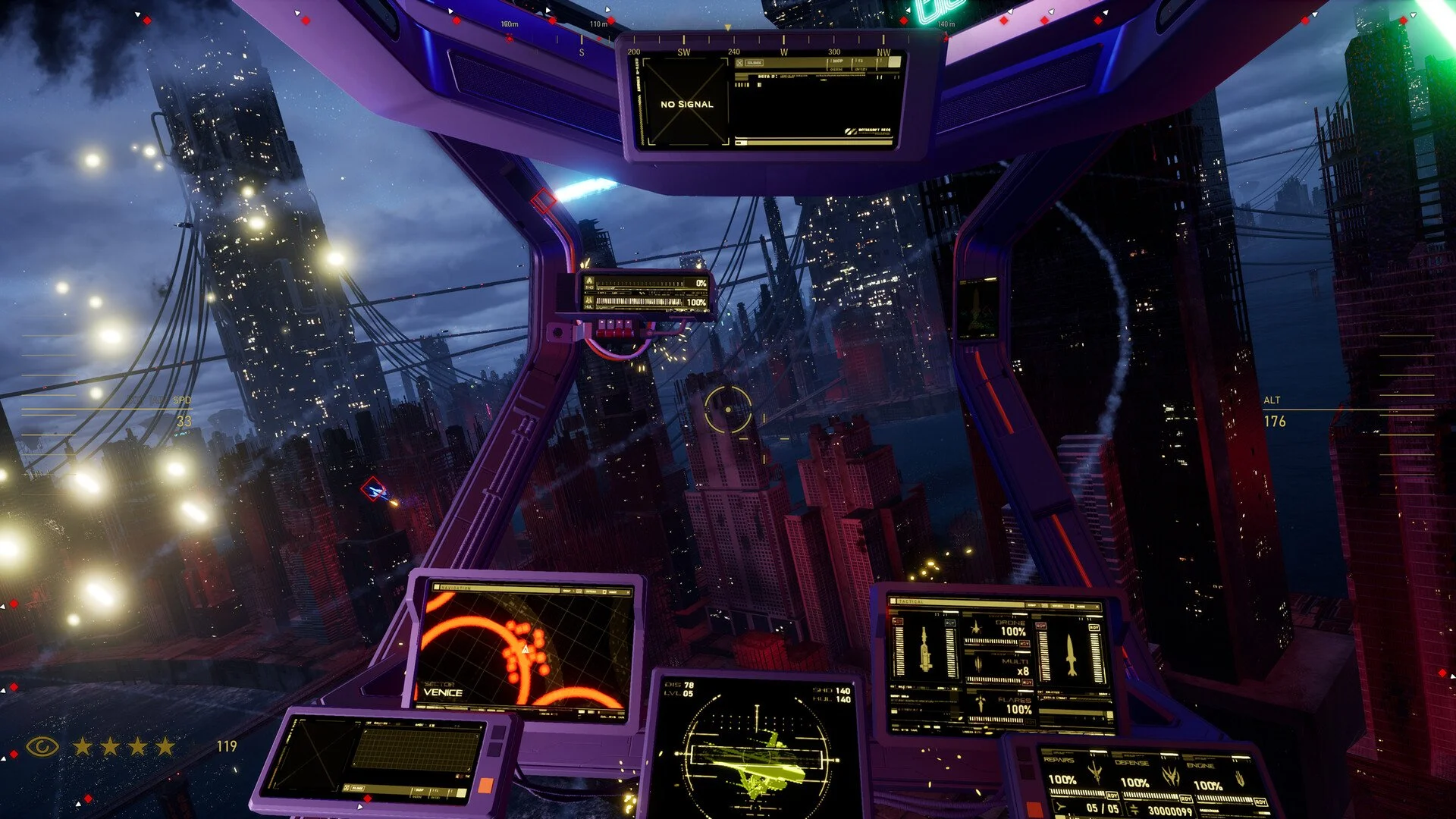
Native VR support uses a first-person cockpit perspective and OpenXR. Official material lists testing with Meta Quest 2, Quest 3, and HTC Vive, while experimental HOTAS and HOSAS support points toward the kind of magnificently unnecessary desk setup flight fans enjoy constructing. Motion controllers are not currently supported, so this is a seated cockpit game controlled with a gamepad, mouse and keyboard, or compatible flight gear - not a reach-out-and-flip-every-switch simulation.
Dogfights in the Urban Canyons
G-Rebels occupies a useful space between arcade immediacy and full simulation. You are not expected to spend half an evening memorizing a startup checklist, but the Skyblade is not a weightless cursor either. Combat asks you to manage speed, position, shields, weapons, targets, and the inconvenient fact that buildings remain extremely solid even in the twenty-seventh century.
The current Early Access release includes the first story chapter, nine campaign missions, and a broader set of side activities - roughly twenty hand-crafted missions in the opening package. Racing, bounty hunting, escort work, smuggling, police pursuits, resource gathering, outpost battles, and larger cruiser encounters give the game more texture than a simple corridor of dogfights.
Credits feed into upgrades for engines, shields, weapons, and other systems. The loop is familiar because it works: take a job, survive the job, improve the Skyblade, then return to the sky with slightly more dangerous equipment and an increasingly flexible definition of responsible policing.
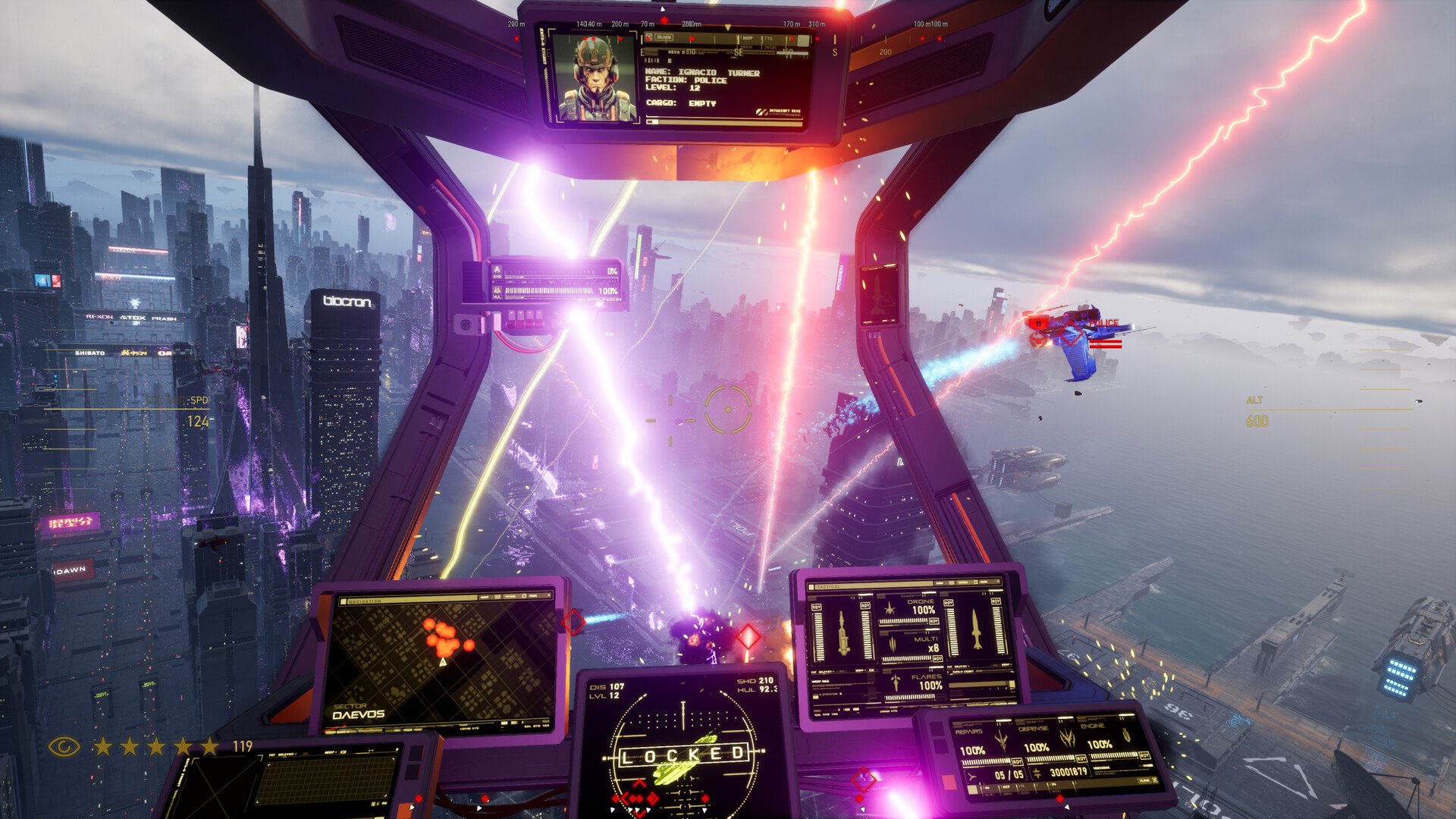
When the pieces align, G-Rebels delivers the fantasy its screenshots promise. You dive through traffic, chase a target between towers, lock missiles while industrial platforms slide past the canopy, and feel every close pass more intensely because VR has placed your nervous system directly inside the vehicle.
The Early Access Warning Light Is Still On
The words Early Access are doing meaningful work here. Public player feedback has praised the world, cockpit immersion, and blend of arcade and simulation, while also pointing to uneven flight handling, control-configuration friction, demanding performance, and VR-specific compatibility problems. Reports have included headset rendering issues and confusion around VR launch options. Those are not minor inconveniences when cockpit immersion is one of the game's defining features.
Handling may be the most divisive part of the package. Some players enjoy the aircraft's weight and momentum; others find it resistant when precision matters. The developers describe Early Access as a period for tuning controls, combat, performance, VR support, open-world systems, and flight hardware, which at least means the roughest areas line up with the parts Reakktor says it is actively improving.
A Huge Sky That Still Needs More Life
The full concept is enormous: more than 12,000 square kilometers, seamless streaming, multiple cities and outposts, dynamic faction conflict, thousands of flying objects, several career paths, and a complete campaign. The current build is a focused opening slice, not the finished realization of every system on the feature list.
Right now, G-Rebels is most convincing when it concentrates on authored missions, city flight, and cockpit spectacle. The long-term challenge is making the space between those highlights consistently interesting. A large map becomes a world only when it produces discoveries, consequences, unexpected encounters, and enough texture that travel feels like possibility rather than commuting with missiles.
The use of AI-generated or AI-modified voices in some dialogue has also drawn criticism. It does not erase the appeal of flying through Daevos, but radio chatter and character performances matter in a story about conspiracies, authority, and rebellion. More distinctive performances would help the human side of the setting keep pace with its excellent steel-and-rain exterior.
Why I Am Rooting for It
G-Rebels is easy to root for because it is doing something specific, expensive-looking, and unfashionably sincere. It revives a style of urban aerial combat the industry mostly abandoned, builds an enormous science-fiction world around it, and then adds native VR support as though the team did not already have enough problems.
Its best moments make a persuasive case that this exact game should exist: a dirty future city, a glass cockpit, bad people on the radar, and several missiles waiting for informed consent. The Early Access build is not yet the complete open-world VR epic suggested by its ambitions. Content is still limited, performance expectations are high, and some players may wrestle with controls or headset compatibility before the fantasy clicks.
But the foundation has personality, scale, and a real reason to be experienced in a headset. Early Access buyers are not purchasing a finished rebellion. They are buying a very promising aircraft while the mechanics are still arguing over the manual.
Welcome Back, CatsAndVR
The easiest thing to do in 2026 is be cynical. Every week another game promises to reinvent everything. Every trailer is the future. Every comment section is ready to pronounce a project dead before the shader cache finishes compiling.
G-Rebels is not asking for that kind of attention. It is asking for patience. It is an Early Access game from a veteran studio trying to revive a style of science-fiction flight game that almost disappeared. Sometimes it stumbles. Sometimes it soars. More importantly, it has ambition - and ambition is something independent VR still desperately needs.
Will everyone love it? No. Is it already the definitive cyberpunk VR flight game? Not yet.
But did it inspire me enough to dust off CatsAndVR after all these years?
Yeah.
And honestly, that may be the nicest thing I can say about it.
